Choose how you want to try N400:
| Goal | What you need | Start here |
|---|---|---|
| Replot saved results | Python environment and figure fonts; no raw EEG or LLM | Replot |
| Run the fixed tutorial | Python environment, figure fonts, Git clone with v0.3.2 tag and ERP CORE data; no LLM | Complete N400 example |
| Use a coding agent | The analysis environment, data, signed-in client, installed skills and configured reviewer | N400 dataset brief |
For the first two routes, complete only Python environment setup
and the environment check,
then return here. Client installation and model access are needed for the agent route.
Raw EEG and cached epochs are not distributed; projects/ is your local workspace.
Run from the repository root, reuse data caches and choose a new output directory.
The figures use Arial or Helvetica. These fonts are not installed by the Conda
environment. Check availability from the repository root with aeais active:
python -c "import sys; sys.path.insert(0, 'tools/examples'); from plot_style import figure_style; print(figure_style()['font.sans-serif'][0])"
If it prints Arial or Helvetica, continue. Otherwise install an available copy
of either font on the machine running Python:
~/.local/share/fonts/ and run fc-cache -f. For WSL, install inside Linux; installing in Windows alone does not supply the Linux font directory. Fontconfig describes its font locations.If a newly installed font is still missing, close Python and clear Matplotlib’s cached font list, then run the check again in a new Python process:
python -c "from pathlib import Path; import matplotlib; [p.unlink() for p in Path(matplotlib.get_cachedir()).glob('fontlist-v*.json')]"
The complete runner checks these fonts before reading EEG or creating its output
directory. Statistical --replay does not render figures and needs no fonts.
Start here to inspect a complete output without downloading source EEG or using an LLM. After checking the figure fonts, run:
python tools/examples/gen_recipe_case_figures.py --run-dir projects/n400-recipe-figure --figure-data tools/examples/n400/recipe_case_figure_data.npz --summary tools/examples/n400/recipe_case_results.json
The three panels show condition/difference ERPs, a descriptive scalp map and all
participant amplitudes. Files appear in projects/n400-recipe-figure/figure-stage/
as F1_n400_recipe.pdf, .svg (editable text), .png (600 dpi) and a caption.
These are saved result arrays, not a new preprocessing or agent run.
The ERP CORE authors provide the dataset through
OSF. Choose
BIDS-Compatible Raw Files, then ERP_CORE_BIDS_Raw_Files.
Reuse an existing local copy first. Otherwise download the root metadata and the
N400 files under sub-001 through sub-020 only, retaining their directory names:
ERP_CORE_BIDS_Raw_Files/
  dataset_description.json, participants.tsv, participants.json
  task-N400_events.json, README, LICENSE
  sub-001/ses-N400/eeg/
    sub-001_ses-N400_task-N400_eeg.set
    sub-001_ses-N400_task-N400_eeg.fdt
    sub-001_ses-N400_task-N400_events.tsv
    sub-001_ses-N400_task-N400_eeg.json
    sub-001_ses-N400_task-N400_channels.tsv
    sub-001_ses-N400_task-N400_electrodes.tsv
    sub-001_ses-N400_task-N400_coordsystem.json
  ... through sub-020
Keep each .set with its external .fdt; the .set alone is insufficient. The
runner reads EEG from .set/.fdt and event onset (seconds) and numeric value
from events.tsv. Retain the sidecars to interpret channels, coordinates and
marker meanings. The separate non-BIDS raw/processed downloads have different
names and are not inputs to this runner.
Pass ERP_CORE_BIDS_Raw_Files directly to the runner. It reads the official
sub-001/ses-N400/eeg/sub-001_ses-N400_task-N400_* layout and existing caches with
sub-001/eeg/sub-001_task-N400_*. No renaming, copying or input-link view is needed.
This post-release example follows the N400 recipe
from v0.3.2 on the fixed 20-participant ERP CORE cohort. Its documented benchmark
branch omits ICA and amplitude rejection. The primary cluster test uses the recipe’s
CPz/Cz/Pz ROI and 300–500 ms window. All participants retained 60 trials per condition;
the mean unrelated-minus-related amplitude was −2.957 µV (SEM 0.466), with one cluster
at p = 0.0002. This ROI test is separate from the historical all-channel certification.
See the complete numerical record.
Pass the dataset root (or your existing compatible cache) as --data-root,
and choose a fresh run directory. The runner downloads nothing. A Git clone with the
v0.3.2 tag is required because it saves that recipe alongside the executed program.
These tutorial scripts are available on main and were added after v0.3.2.
Complete the font check before the full run, which also
renders figures. Before reading EEG or creating outputs, the full runner checks
that all 20 participants have a .set, its companion .fdt and matching
events.tsv, in either supported layout above. This checks file presence only;
it does not establish data validity.
python tools/examples/run_recipe_case.py --data-root /path/to/ERP_CORE_BIDS_Raw_Files --run-dir projects/n400-recipe-case/runs/run-001
python tools/examples/run_recipe_case.py --run-dir projects/n400-recipe-case/runs/run-001 --replay
The full run prints stage messages like these, repeating the subject stage for all 20 participants:
[inputs] Checking files for 20 participants...
[subject 1/20] sub-001: preprocessing, epochs and averages...
...
[statistics] Computing group clusters (5000 permutations)...
[replay] Checking saved group statistics (5000 permutations)...
[figures] Rendering figures...
[report] Saving methods and summary...
The run saves the brief, frozen plan, program, preprocessed EEG, epochs, averages,
statistics, figures and methods. Start inspection at stats-stage/summary.json,
figure-stage/F1_n400_recipe.png and report-stage/methods.md; the run’s plan.json
records the full configuration. Completion means the terminal reports
"status": "complete", process.json has "exit_code": 0, and the run directory’s
summary.json has "status": "complete" and "required_stages_complete": true.
The replay check in audit-stage/replay.json must have "passed": true.
Replay checks group statistics from saved participant averages, without repeating preprocessing. In the retained run, t maps, cluster masks, p values and permutation null values were identical. This is an internal worked example, not an estimate of LLM success rate or time savings.
Keep run-001, its process.json when created, and the terminal error. Fix the
reported problem, then use a fresh directory to rerun all 20 participants:
python tools/examples/run_recipe_case.py --data-root /path/to/ERP_CORE_BIDS_Raw_Files --run-dir projects/n400-recipe-case/runs/run-002
--replay only recomputes group statistics from a completed run’s saved arrays;
it does not resume interrupted preprocessing or finish figures and reports.
This route uses a coding agent, rather than the fixed Python runner. Complete
agent setup, including its reviewer.
Create projects/n400-agent/ and save the following as its DATASET_BRIEF.md.
Replace the raw-data path with the absolute path to your existing ERP CORE root;
keep the source files there, outside the study directory.
# ERP CORE N400 dataset brief

- Study directory: projects/n400-agent
- Raw data root: /absolute/path/to/ERP_CORE_BIDS_Raw_Files (read only)
- Source: ERP CORE BIDS-Compatible Raw Files, https://osf.io/9f5w7/
- Recipe: n400-semantic
- Participants: sub-001 through sub-020, selected before analysis
- Design: within participant; participant is the independent observation
- Layout: sub-NNN/ses-N400/eeg/sub-NNN_ses-N400_task-N400_*
- Input: .set with companion .fdt; matching events.tsv and BIDS sidecars
- Expected recording: 30 scalp EEG channels plus 3 EOG channels at 1024 Hz;
  verify the headers and coordinate units against the source sidecars
- Event timing: events.tsv onset in seconds; codes in numeric value column
- Time lock: target words, not primes or responses
- Related targets: 211 and 212
- Unrelated targets: 221 and 222
- Exclude from target epochs: prime codes 111, 112, 121 and 122, and responses
- Question: do unrelated targets evoke a more negative N400 than related targets?
- Primary contrast: unrelated minus related
- ROI and window: CPz, Cz, Pz; 300–500 ms after the target
- Plan status: not approved; propose cleaning and statistical settings,
  list unresolved choices and wait for researcher approval before analysis
The generic auto_brief scanner reads only the top level of raw/; do not point it
at this nested BIDS root. The agent should read the saved brief, inspect the nested
EEG headers and matching events directly, and draft an
analysis plan.
From the repository root with aeais active, enter this inside Codex:
$eeg-recipe n400-semantic --data projects/n400-agent
Read projects/n400-agent/DATASET_BRIEF.md and use its external raw-data root without moving the data.
Inspect the nested BIDS files directly. Draft the plan, list unresolved choices,
and stop for my approval before analyzing EEG.
In Claude Code, use /eeg-recipe instead of $eeg-recipe. For your own recordings,
adapt the general dataset brief,
participants, event mapping, hypothesis, ROI and window to your design.
The recorded N400 agent workflow illustrates the three steps below; the new brief
does not approve that run’s cleaning choices for your analysis.
| Step | Researcher and agent actions | What to inspect |
|---|---|---|
| Research request | Supply the data paths, participants, event mapping and hypothesis in the brief above | Target timing and condition counts; 211/212 related, 221/222 unrelated |
| Researcher approval | Review the agent’s plan and freeze contrast, ROI/window, cleaning, eligibility and statistical settings | ANALYSIS_PLAN.md; ambiguous ICA components need a further response |
| Generated code and results | The agent writes and runs scripts for preprocessing → ICA → epochs → ERP → statistics → figures/report, retaining the outputs | Scripts and commands, participant counts, condition averages, statistics, figures, methods, review records and saved-program replay comparison |
In the recorded agent run, the researcher approved ICA plus local AutoReject and native 1024 Hz sampling. The plan fixed a 0.1–30 Hz filter, −200 to 800 ms epochs, −200 to 0 ms baseline, at least 30 retained targets per condition, and a negative-tailed group cluster test with 5,000 permutations and seed 42 in the stated ROI/window. Ambiguous ICA components required a further researcher response. These choices differ from the fixed no-ICA, 256 Hz tutorial above, so its numerical results are not the agent run’s results. A new study likewise needs its own approved plan and checks; changing event labels alone does not validate it.
The examples below are historical records, rather than current tutorial commands. Their original plans, scripts, positive and null results, corrections and audits are retained in existing Git history.
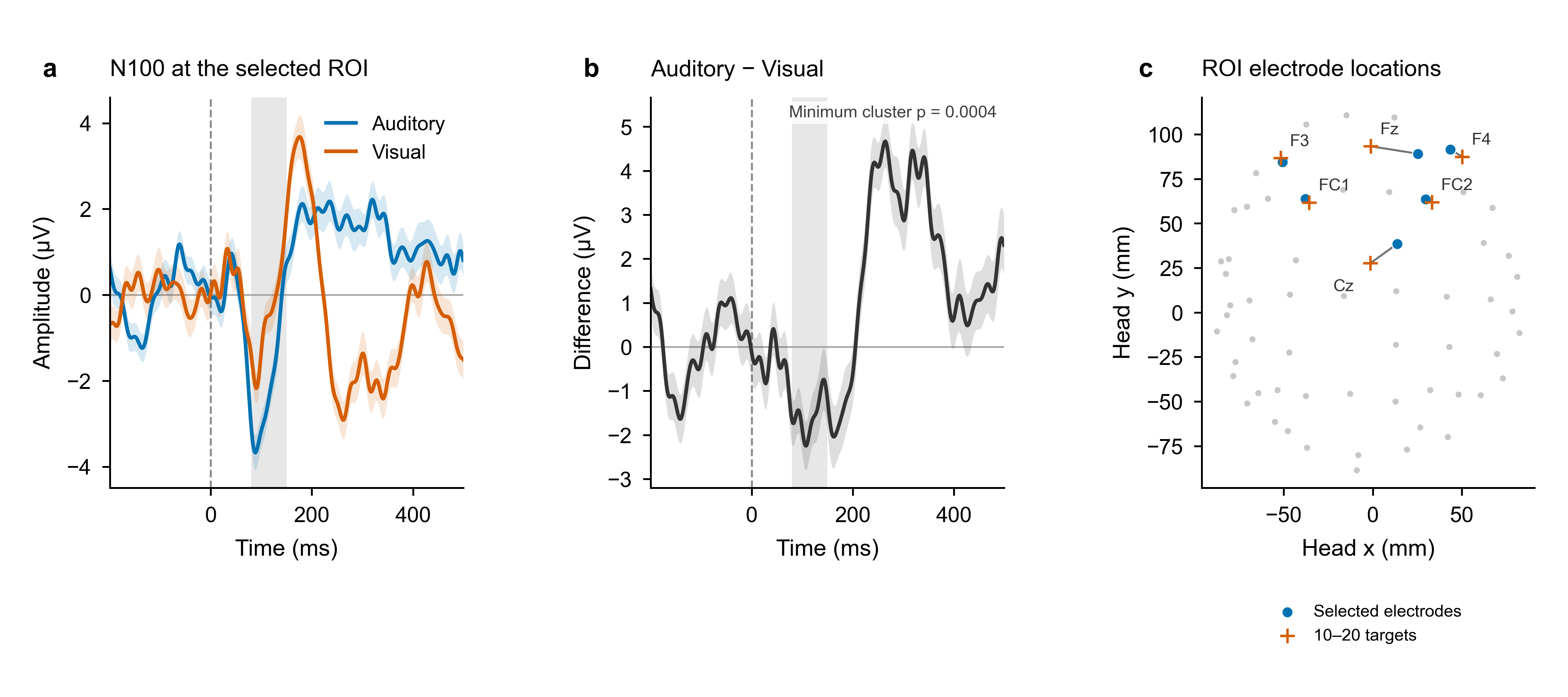
The corrected single-participant analysis uses 61 complete stimulus cycles (244 trials) and six ROI electrodes with 3–27 mm location differences. Auditory minus visual amplitude was −1.54 µV, paired-cycle Cohen’s d_z = −0.462, with one cluster at p = .0004 (5,000 permutations). Shading in the figure is ±1 SEM across cycles. Original target-epoch retention was 289/289; the correction separately excluded 45 target trials in incomplete cycles, rather than rejecting them as artifacts. Fixed stimulus order confounds condition with cycle position. The sign-flip test assumes independent, symmetric cycle differences and does not establish a population effect.
Corrected record · result JSON · corrected figure · original figure · historical instructions and commands.
The preparation, analysis, and plotting scripts remain in that snapshot. The published correction reused saved epochs; preparation refits ICA and requires numerical comparison before treating a new run as the same result.
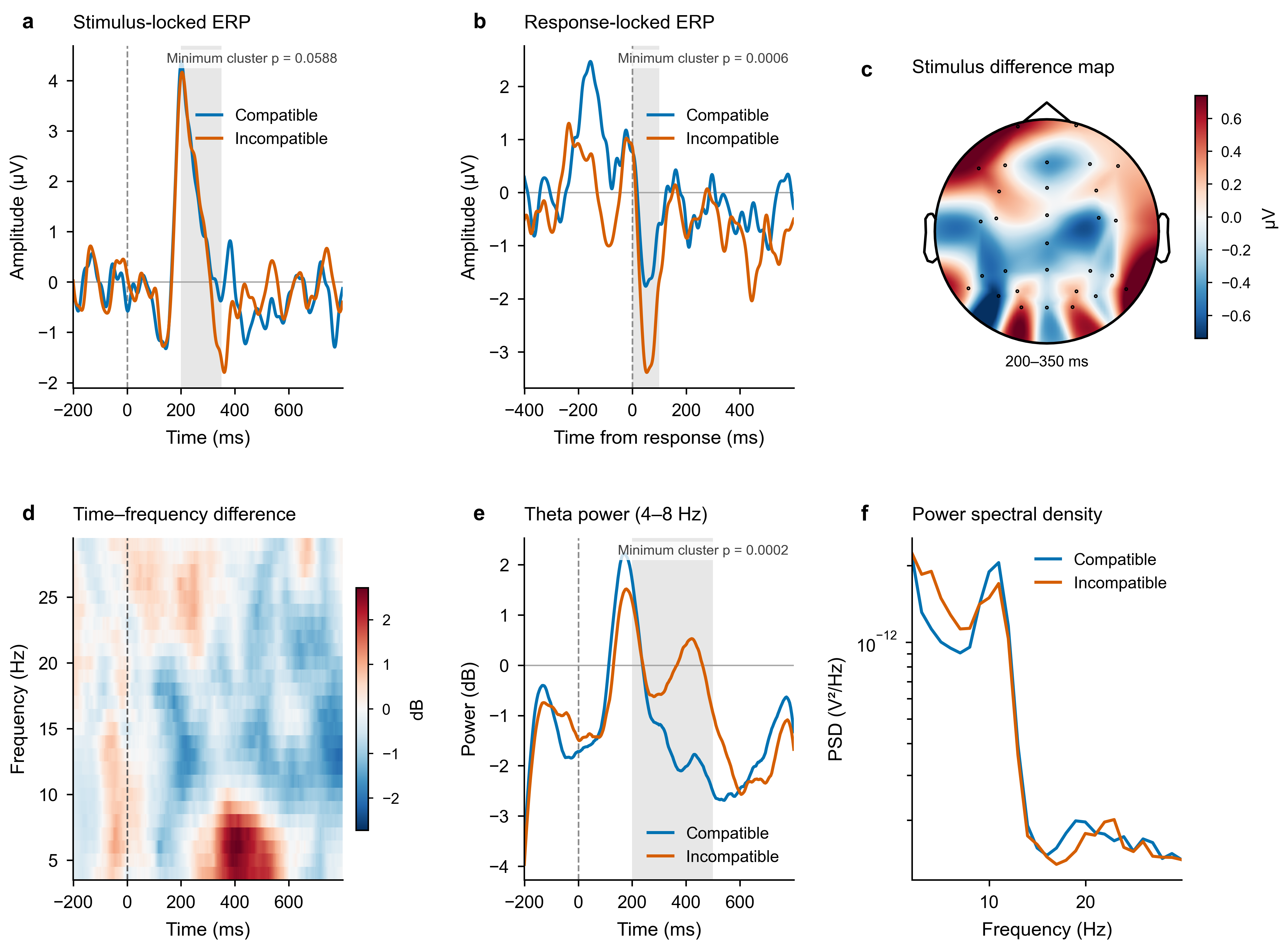
The corrected Subject-001 example retains all three planned contrasts. Minimum cluster p values were N2 .0588 (d = −0.062), response-locked conflict .0006 (d = −0.316), and theta .0002 (d = 0.295): two pass p < .05/3. All retained trials enter 5,000 permutations restricted by block × target side. Theta uses joint frequency × time × electrode clusters. The response contrast is incompatible minus compatible, separate from canonical error-minus-correct ERN. Restricted permutations assume exchangeability within strata; this single-participant result does not establish a population effect.
Recipe · corrected record · result JSON · corrected figure · original figure · historical instructions and commands.
The analysis and plotting scripts remain in the snapshot. The original pipeline reported 94.6 s; corrected analysis took 12.60 s from saved epochs, excluding upstream stages and rendering. These different stages do not establish complete-pipeline or LLM-related speedup.
These known-effect checks cover alpha power, complexity and microstates. Read the original findings with the audit follow-ups: alpha was spatially diffuse, LZC lost the contrast without ICA, microstate duration depended on smoothing, and anesthesia was untested. Original results and follow-up results remain in the public snapshot; certification coverage is recorded separately.
The recorded validation script is available in the fixed public snapshot. Use the recipes above for a new analysis.
The post-release identity check maps original event rows, retention and sample positions for all 120 original subject-component records, including the eight excluded records. Retained trial identities agree in 111 of the 112 certified common records; MMN sub-030 has one additional deviant in the reference. Event timing can differ by one resampled sample even when identity agrees. Original AEA counts and stored-precision amplitudes are reproduced. The check compares AEA with retained MNE-BIDS-Pipeline outputs; it does not add EEGLAB/FieldTrip trial identities.
The recorded identity-check script
requires the original ERP CORE caches and retained reference derivative
FIF files under ~/mne_data. It regenerates original AEA subject processing and reads
the reference files; it does not run group permutations or overwrite the published
results. New records are written under projects/trial-identity/.
The script is available in the fixed public snapshot; it is not part of a new recipe run.