
Dengzhe Hou (侯登哲)
I am an Assistant Professor at Tohoku University, Japan.
My research spans AI4Brain (AI for understanding the brain) and Brain4AI (brain and cognitive science for understanding and improving AI).
Background & research interests
At the Graduate School of Information Sciences (GSIS), I am affiliated with the Yamada Laboratory and the International Liaison Office (ILO), with a concurrent appointment in the Social Integration Research Division of the Unprecedented-scale Data Analytics Center (UDAC).
I received my Ph.D. under Prof. Satoshi Shioiri at the Visual Cognition and Systems Laboratory, and was a Visiting PhD Scholar in the Sydney Cash Lab at Harvard Medical School / Massachusetts General Hospital.
My work focuses on two connected directions:
- AI4Brain: Reliable decoding and automated analysis of EEG, including preprocessing-induced instability, per-trial uncertainty, and feature attribution; understanding self-initiated attention through EEG, eye tracking, and computational modeling.
- Brain4AI: Drawing on cognitive neuroscience to understand, evaluate, and improve AI systems, with a focus on working memory, cumulative state tracking, and the structure of cognitive abilities in large language models.
Connecting these directions, my current work explores aligning brain signals (EEG, fMRI) with representations in large language and vision-language models.
Selected Research
 View figure
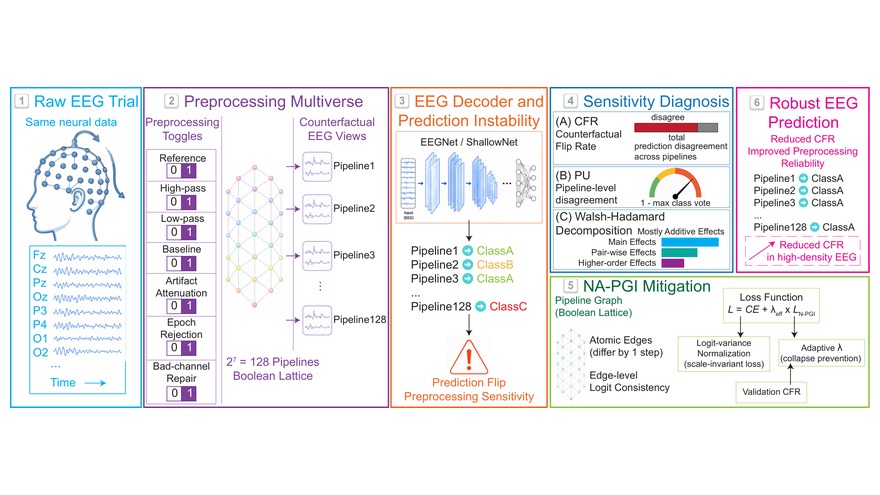
 Same Brain, Different Prediction
Changing only the preprocessing pipeline can flip up to 42% of EEG predictions. We measure this instability and introduce a method to reduce it.
Read more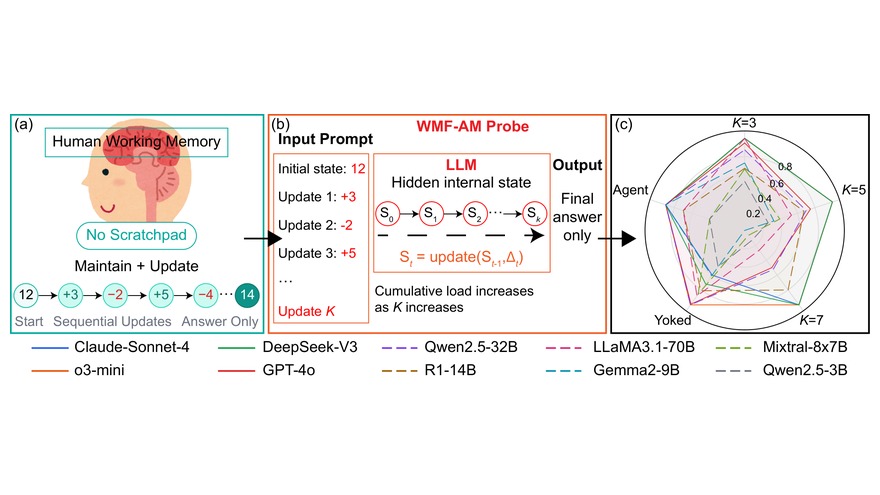 View figure
 Probing Working Memory in LLMs
WMF-AM tests whether language models can maintain and update intermediate results without a scratchpad. The probe spans 28 models from 12 families.
Read more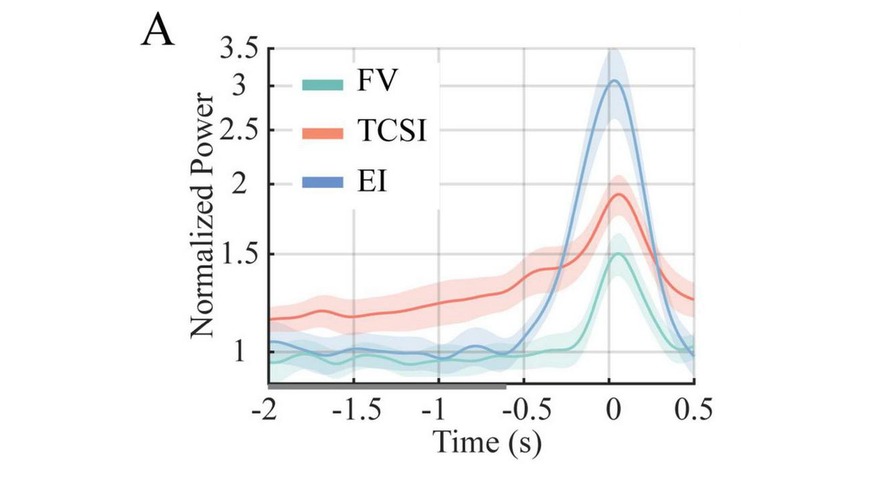 View figure
 Frontal-Midline Theta Ramping
EEG and eye tracking reveal frontal-midline theta ramping before self-initiated attention shifts, providing a neural marker of voluntary attentional preparation.
Read moreNews
| Sep 2026 | Invited talk at RSJ2026 Open Forum OF7, “テクノロジーの質的進化と組織統制”, 44th Annual Conference of the Robotics Society of Japan, Kanazawa. Speaking on neurotechnology with Michael Zielewski |
| Aug 2026 | Co-authored presentation accepted at the Japan Institute of Marketing Science (JIMS) Research Conference, Waseda University, 14–15 Nov 2026: “生成AI活用事例における社会倫理的リスクと炎上要因の定量分析” |
| Aug 2026 | Paper accepted at IEEE SMC 2026 (Bellevue, USA), Subject-Specific Analysis of Self-Initiated Attention Shifts from EEG |
| Aug 2026 | TimePre accepted at Transactions on Machine Learning Research (TMLR) |
| Aug 2026 | Awarded a research grant (PI) from GSIS, Tohoku University, under Interdisciplinary Research Project Development Support: 認知科学実験パラダイムに基づくAIシステム認知能力評価プラットフォームの開拓 |
| Aug 2026 | New preprint on arXiv, Control-Diverse Reinforcement Fine-Tuning. RL post-training concentrates control on a shared set of components across tasks, even where activations look diverse — and relieving that bottleneck improves multi-task performance |
| Aug 2026 | Invited talk at the 12th Annual CWRU-Tohoku Data Science in Engineering and Life Sciences Symposium, Cleveland, USA: “From Preprocessing Choices to LLM Agents: Automated and Verifiable Cognitive EEG Analysis” |
| Aug 2026 | Awarded KAKENHI Grant-in-Aid for Research Activity Start-up (PI, 26K25566): the representational format of attentional templates, probed with computational model hierarchies, EEG and eye tracking |
Earlier news
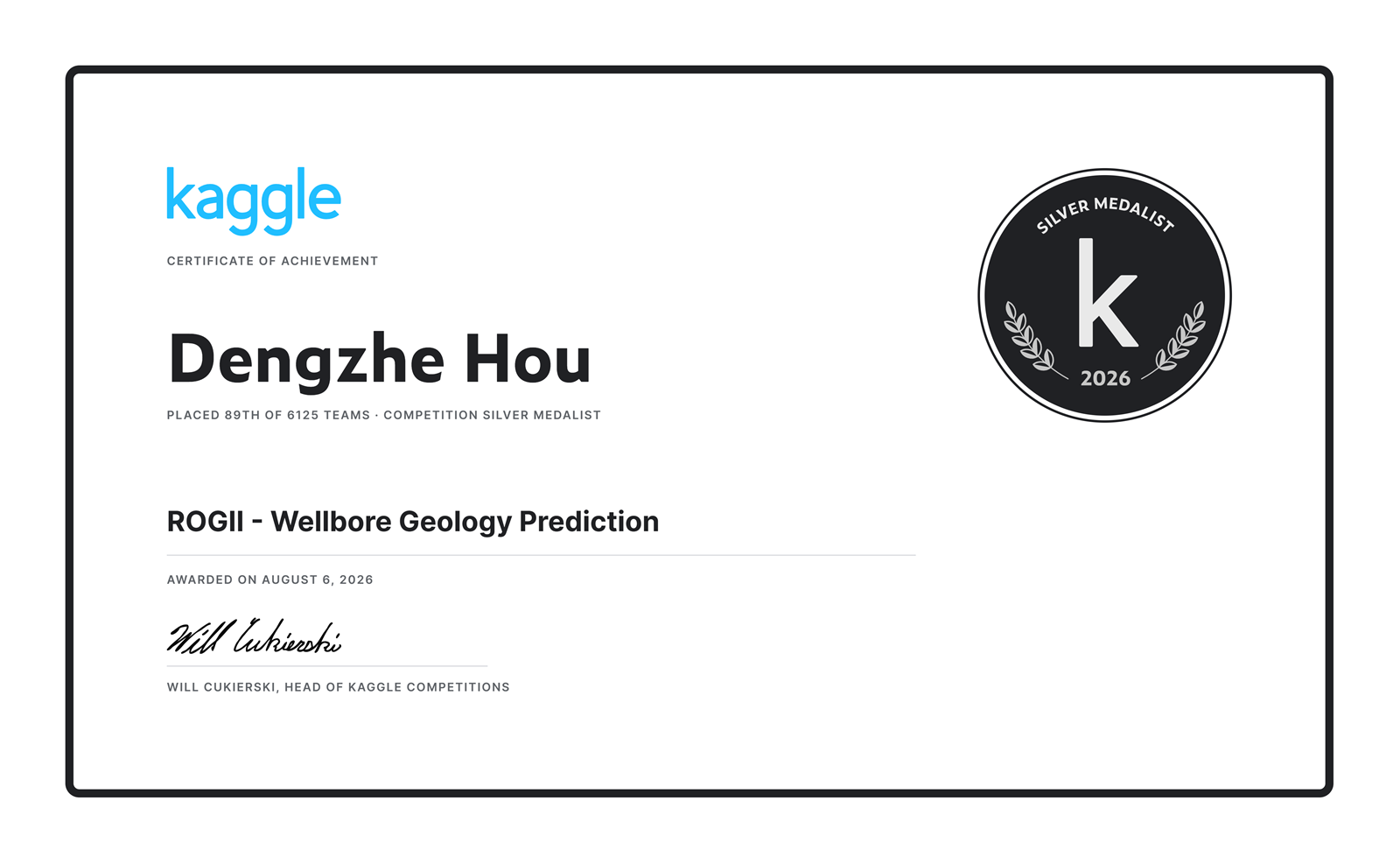
| Aug 2026 | Kaggle Silver Medal in ROGII - Wellbore Geology Prediction (89/6125) |
| Jul 2026 | KANMixer published in Scientific Reports: a compact KAN-centered mixer for long-term forecasting, and an honest account of when KANs actually help |
| Jul 2026 | Two new preprints on arXiv: CogEEGAgent (autonomous cognitive EEG analysis) and CogArena (cognitive ability structure in LLMs) |
| Jul 2026 | Awarded a research grant (PI) from the Center for So-Go-Chi (Convergence Knowledge) Informatics, Tohoku University |
| Jul 2026 | Appointed to the Editorial Board of Interdisciplinary Information Sciences (Tohoku University GSIS) |
| Jun 2026 | Joined the Tohoku University × NTT DATA Group joint research on technology governance (TechGov) as a research member |
| Jun 2026 | PVIR poster presented at CVPR 2026 Workshop VGBE, Denver, Colorado |
| May 2026 | Joined the TechGov initiative at UDAC, Tohoku University |
| May 2026 | New preprint on arXiv, Subject-Specific Analysis of Self-Initiated Attention Shifts from EEG. SHAP-based within-subject decoding of self-initiated attention |
| May 2026 | New preprint on arXiv, Same Brain, Different Prediction. Preprocessing pipelines flip up to 42% of EEG decoding predictions, and we introduce a diagnostic and a regularization fix |
| May 2026 | Updated preprint. WMF-AM v2 reframes our LLM probe around working-memory depth and isolates cumulative state tracking as the dominant bottleneck |
| Apr 2026 | Collaborator on new preprint, Vibe Medicine: Redefining Biomedical Research Through Human-AI Co-Work |
| Apr 2026 | Started as Assistant Professor at GSIS, Tohoku University (Yamada Lab, ILO) with concurrent appointment at UDAC Social Integration Research Division |
| Apr 2026 | Teaching Machine Learning Basics at GSIS, Tohoku University |
| Mar 2026 | Paper accepted at CVPR 2026 Workshop VGBE, Physics-Aware Video Instance Removal Benchmark |
| Mar 2026 | First version of the LLM working-memory probe on arXiv, then titled Beyond Completion: Probing Cumulative State Tracking to Predict LLM Agent Performance (later revised and retitled WMF-AM) |
| Feb 2026 | Participated in Qualia Structure Grant Meeting |
| Feb 2026 | Appeared in Journal Club: The Proliferation of Consciousness Theories: What can we do next? (Neural basis of Consciousness & Qualia Structure) |
| Dec 2025 | Paper published in Frontiers in Human Neuroscience, frontal-midline theta ramping indexes self-initiated attention shifts |
| Apr 2025 | Awarded JSPS DC2 Research Fellowship |
| Jan 2025 | Returned from visiting scholar position at Harvard Medical School / MGH (Sydney Cash Lab, supervised by Dr. Jing (Jill) Cai) |
| Dec 2024 | Best Presentation Award, 32nd Doctoral Student Presentation, Tohoku University |
| Oct 2024 | Presented two posters at Society for Neuroscience 2024 |
| Jul 2024 | Two presentations at APCV 2024 (The 16th Asia Pacific Conference on Vision) |
| Aug 2023 | Oral presentation at ECVP 2023, Paphos, Cyprus; awarded ECVP Student Travel Award |
Education
Ph.D. · Information Sciences
Apr 2023 – Mar 2026Graduate School of Information Sciences, Tohoku University
Thesis, advisors & programs
- Thesis: Exploring Brain Mechanisms of Self-Initiated Attention Shift: Simultaneous Recording of EEG and Eye Movements
- Advisors: Prof. Satoshi Shioiri, Prof. Shuichi Sakamoto, Prof. Chia-huei Tseng
- Visual Cognition and Systems Lab · Graduate Program in Data Science (GPDS)
- JST Next Generation Researcher Challenging Research Program
M.S. · Information Sciences
Apr 2021 – Mar 2023Graduate School of Information Sciences, Tohoku University
Advisors & program
- Advisors: Prof. Satoshi Shioiri, Prof. Chia-huei Tseng
- Visual Cognition and Systems Lab · GPDS (joined Apr 2022)
B.Eng. · Electronic and Information Engineering
Sep 2016 – Jul 2020Tongji University · Automation
Advisor & academic record
- Advisor: Assoc. Prof. Xia Zhao
- GPA 4.15 / 5.0
Teaching
Instructor, Graduate School of Information Sciences, Tohoku University
Machine Learning Basics
Apr 2026 – presentGSIS, Tohoku University · GPDS. Course materials adapted from Samy Baladram.
Data Science Training II & Data Science Challenge
Jun 2026 – Jul 2026GSIS, Tohoku University
Teaching Assistant, Graduate School of Information Sciences, Tohoku University (2022 – 2025)
Supervisors: Prof. Kazunori Yamada, Assoc. Prof. Samy Baladram
- Spring 2024: Machine Learning Basics, Data Science Programming Basics, Data Engineering, Data Science Training I & II
- Fall 2023: Data Science Basics
- Spring 2022: Data Science Training I, Data Science Skill Up Exercise
Grants, Fellowships & Awards
| 2026–2027 | KAKENHI Grant-in-Aid for Research Activity Start-up (PI, 26K25566): 注意テンプレートの表象形式:計算モデル階層・脳波・視線追跡による解明 (¥2,600,000) |
| 2026 | Kaggle Silver Medal, ROGII - Wellbore Geology Prediction (89/6125), certificate |
| 2026 | Research Grant (PI), Center for So-Go-Chi (Convergence Knowledge) Informatics, Tohoku University (¥400,000) |
| 2026– | Research Member, Tohoku University × NTT DATA Group Joint Research on Technology Governance (TechGov, UDAC) (¥1,000,000 individual allocation, of ¥40,000,000 total project) |
| 2026 | Research Grant (PI), Interdisciplinary Research Project Development Support, Graduate School of Information Sciences (GSIS), Tohoku University: 認知科学実験パラダイムに基づくAIシステム認知能力評価プラットフォームの開拓 (¥500,000) |
| 2026 | Kaggle Expert – Bronze Medal, CSIRO Image2Biomass Prediction (355/3805) |
| 2025–2026 | JSPS DC2 Research Fellowship (completed) |
| 2025 | Kaggle Bronze Medal, Santa 2024: The Perplexity Permutation Puzzle (148/1514) |
| 2024–2028 | KAKENHI Grant-in-Aid for Scientific Research (A): 自発的脳機能の神経基盤理解 (PI: Prof. Satoshi Shioiri) |
| 2024 | Best Presentation Award, 32nd Doctoral Student Presentation, Tohoku University |
| 2023 | ECVP Student Travel Award |
| 2023–2025 | JST Next Generation Researcher Challenging Research Program |
| 2022–present | Tohoku University GPDS Research Assistant |
| 2021–2023 | Kamei Memorial Foundation Scholarship for International Students (公益財団法人亀井記念財団) |
| 2016 | Tongji University Undergraduate Entrance Scholarship |
Editorial Board
- Editorial Board Member, Interdisciplinary Information Sciences (Tohoku University GSIS), 2026–present
Reviewer
- npj Science of Learning
- Cognitive Neurodynamics
- Journal of NeuroEngineering and Rehabilitation
- Scientific Reports
- Discover Neuroscience
- European Conference on Machine Learning and Principles and Practice of Knowledge Discovery in Databases (ECML PKDD 2026)
- International Joint Conference on Neural Networks (IJCNN)
Links
- International Liaison Office (ILO)
- Graduate Program in Data Science (GPDS)
- Yamada Laboratory
- TOHOKU AI GROUP, Artificial Intelligence Research Group at Tohoku University
- Graduate School of Information Sciences (GSIS), Tohoku University
- Unprecedented-scale Data Analytics Center (UDAC), Social Integration Research Division
- Collaborative Research Laboratory for Technology Governance (TechGov), Tohoku University × NTT Data Group